· FUTURE CONCEPT
QUIET CuffExploring silent wrist input
A curved porcelain-coloured electronics pod rests on two visible metal bridges above a flexible band. A removable contact assembly and a physical stop control shape a proposed surface-muscle and motion interface.
Original design · Prototype validation pending
View the design poster ↗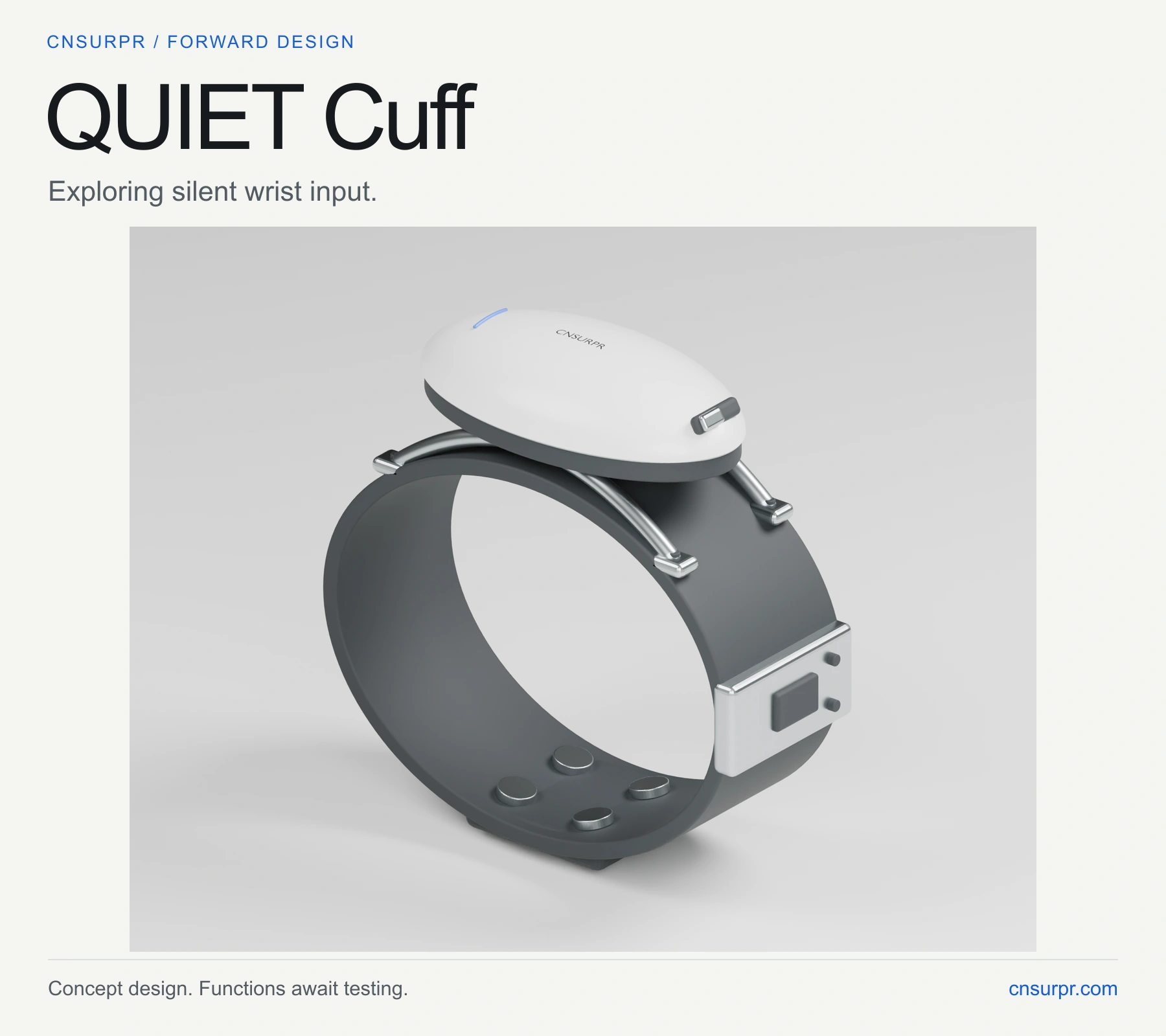
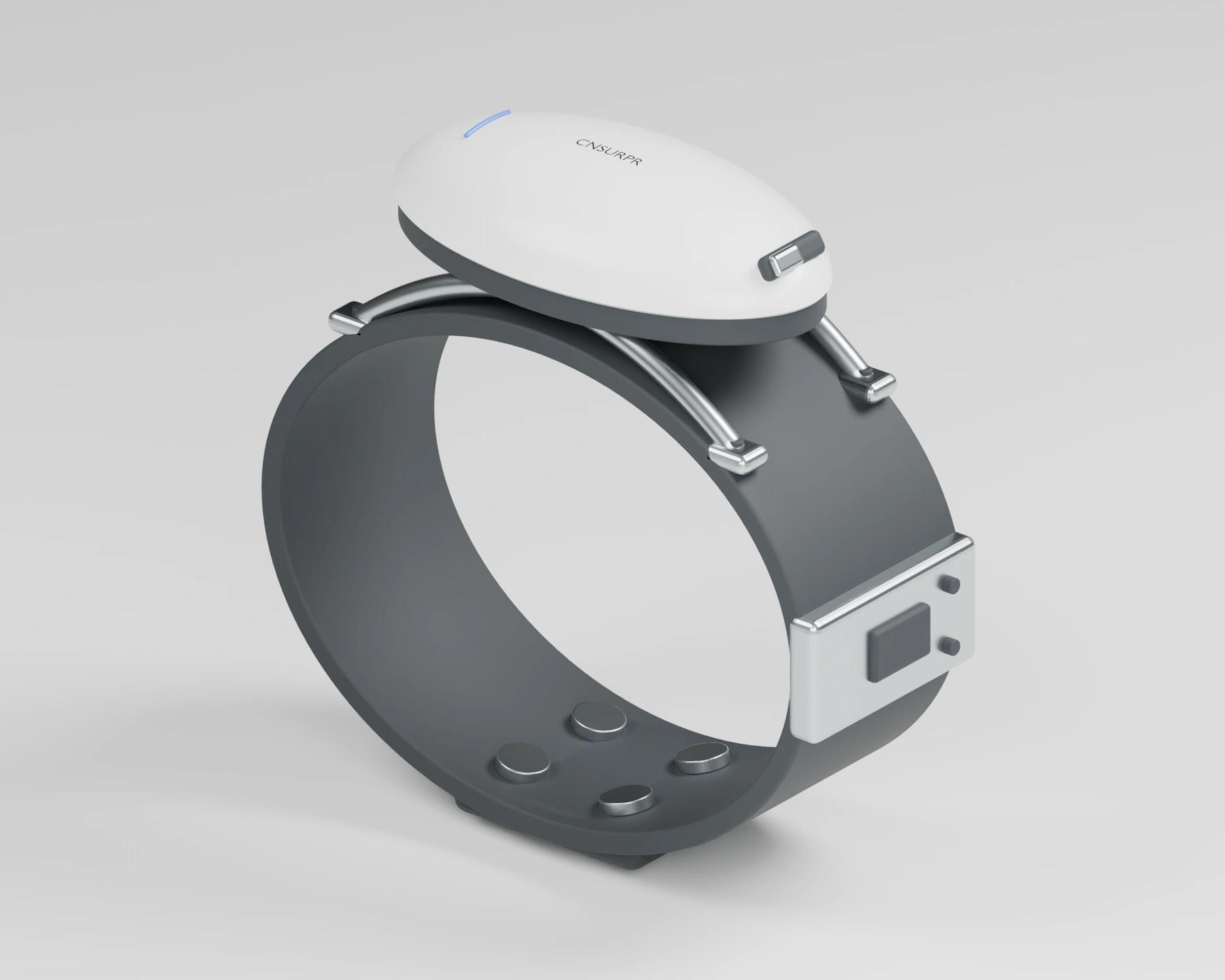 DESIGN STUDY · 1.2
Drag to orbit, or use the buttons. No automatic motion. Geometry illustrates an idea; it is not a validated assembly.
Why design ahead in this category?
Commercial wrist input exists beyond one supplier, while glasses and personal computing create candidate uses for quiet control. We are exploring whether serviceable contact parts and clear control states improve repeated use. Public data do not yet establish a broad consumer breakout.
Independent commercial revenue signal
~19%Wearable Devices · H1 2026 versus H1 2025, USD350k versus USD294k. Consolidated unaudited revenue, not units or November demand.
Read source ↗Established launch route
2025.09Meta announced a glasses-and-EMG-band bundle. This is launch evidence; standalone band sales are not supplied.
Read source ↗Accessible technical route
sEMG + IMUuMyo documents a single-channel sensor and a bridge pipeline. It is not a ready-made universal HID device or our tested decoder.
Read source ↗The product advantage to test
Proposed differentiation is a separately serviced contact assembly, removable electronics and explicit sensing control. Contact stability, redon effort, false activations and task completion are comparison goals, not measured advantages.
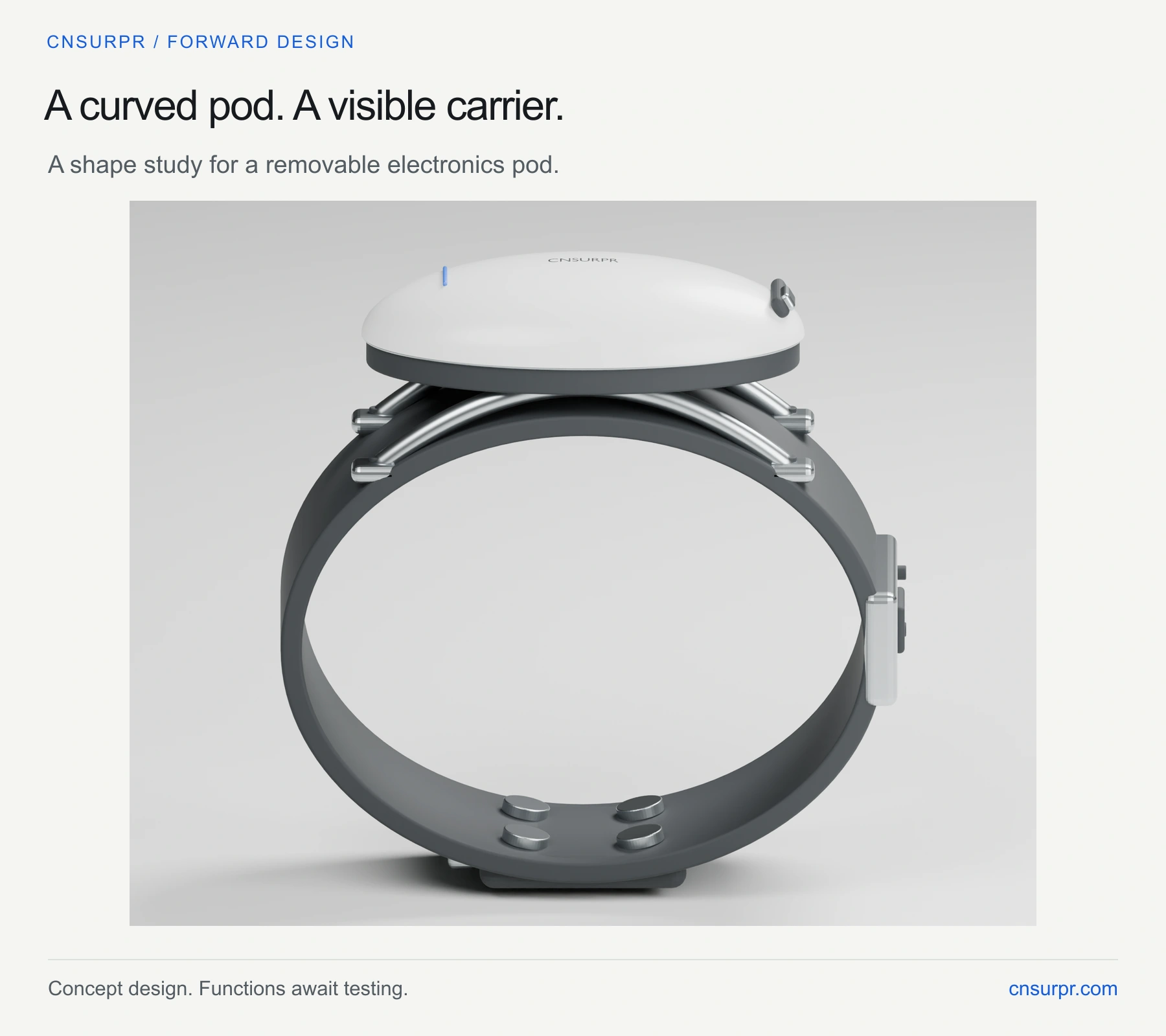
Curved pod and contact band
The curved cap expresses the proposed electronics envelope. Component packing has not been validated.
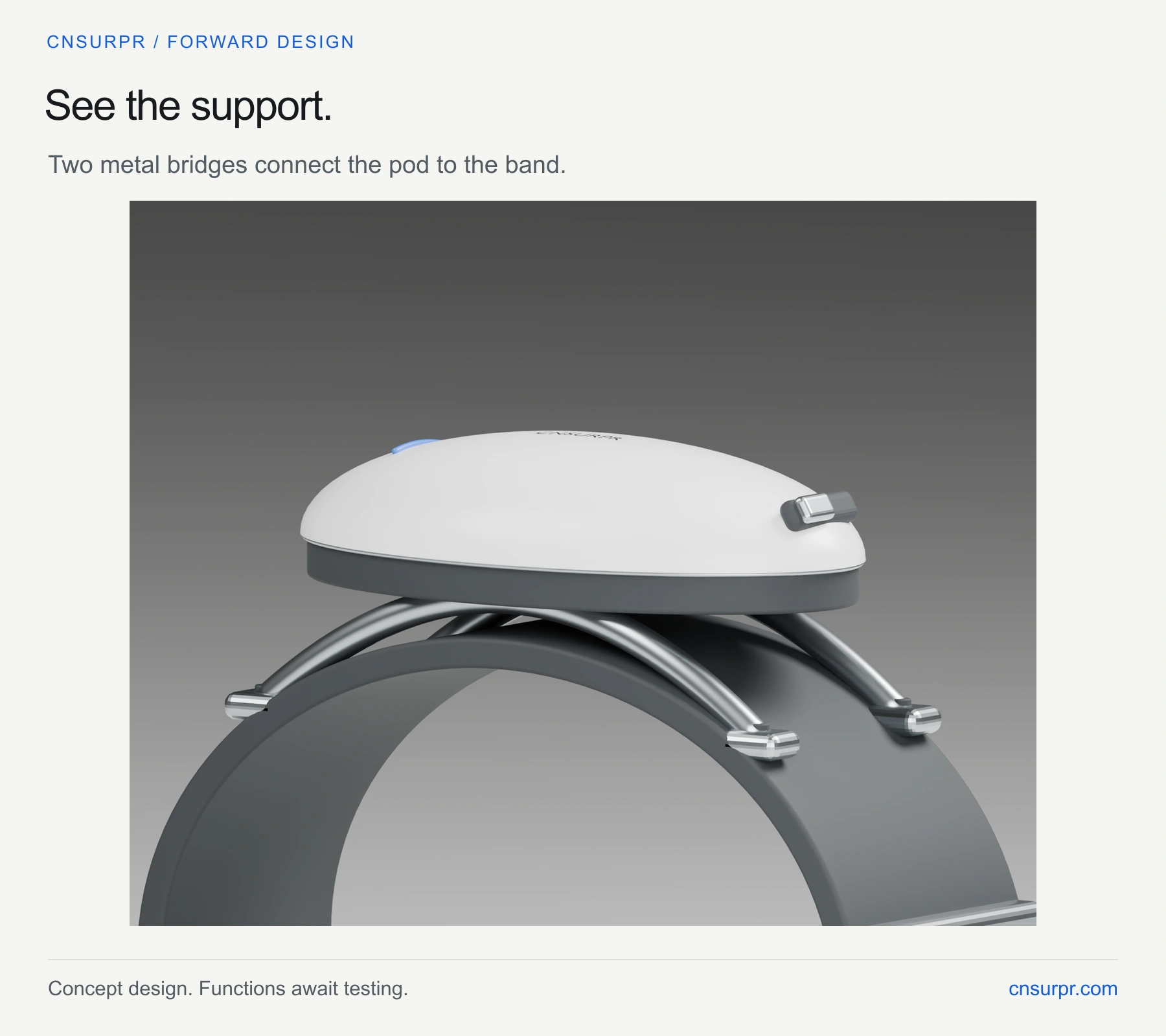
A gap with visible supports
Two metal bridges connect to physical feet. Strength and attachment details await engineering.
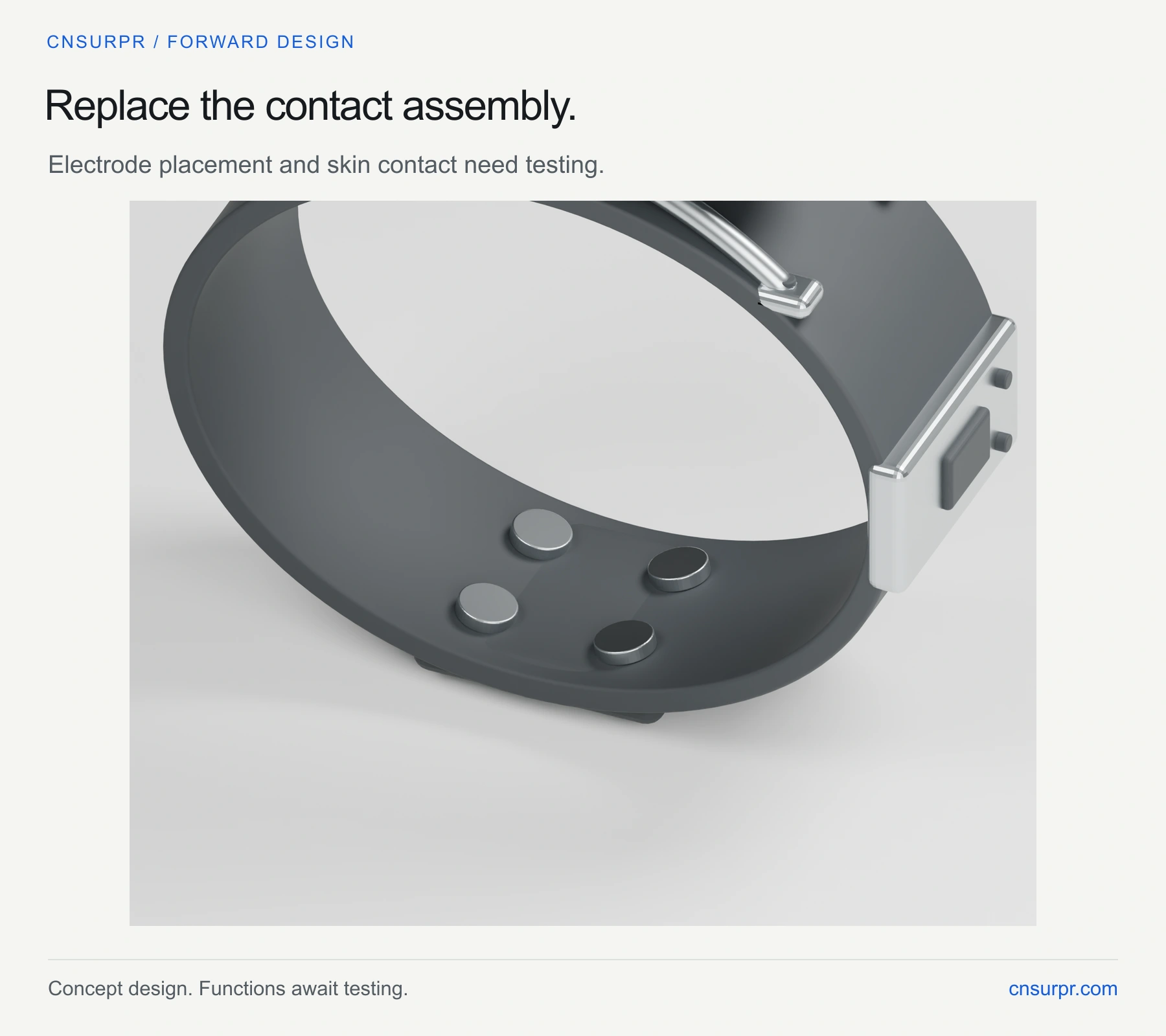
Service the contact parts
Four pads illustrate a contact layout, not a confirmed number of sensing channels.
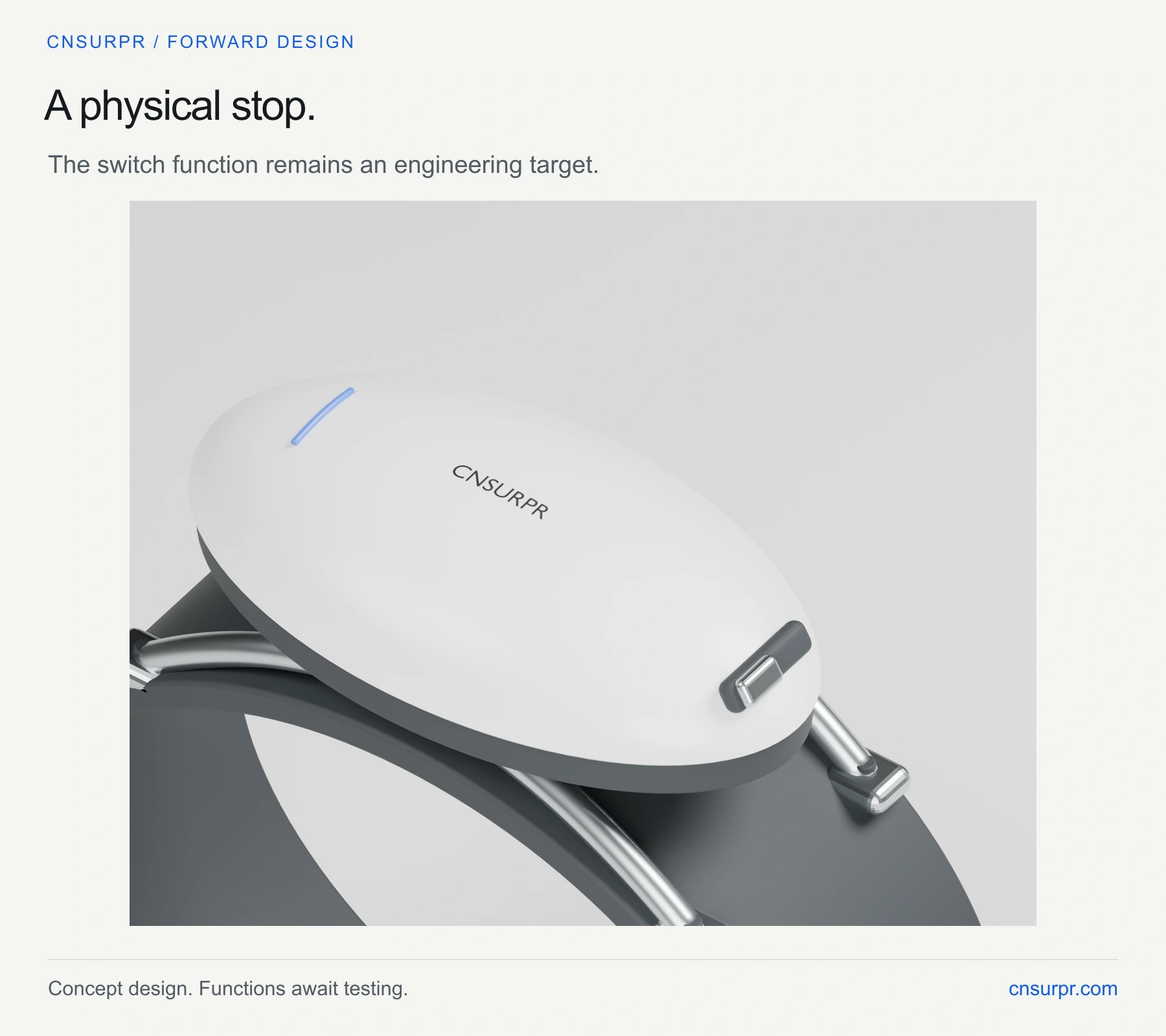
Stop and sensing state
A physical slide and status window are proposed. Electrical isolation and indication require testing.
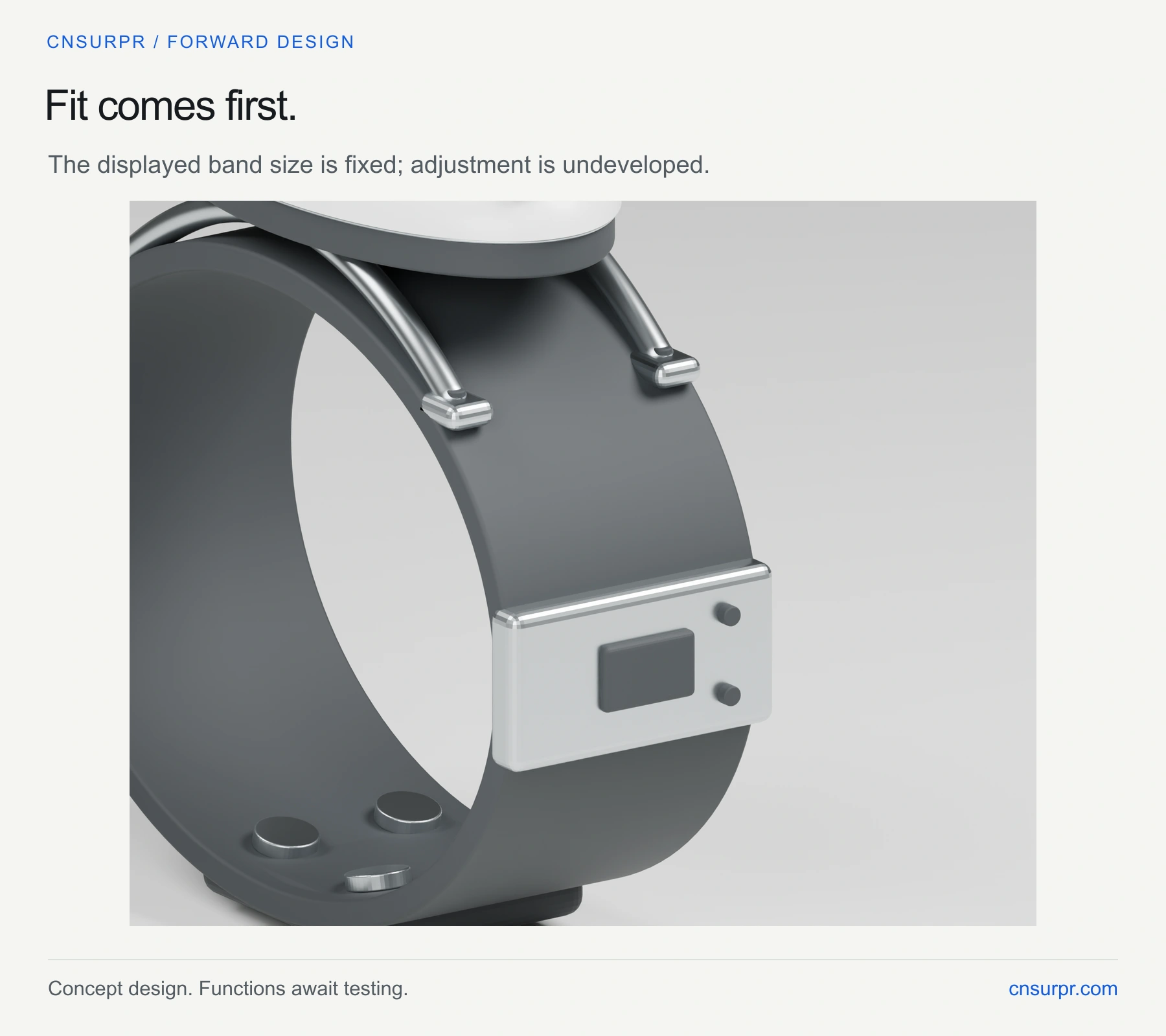
Fit and refitting
This is a fixed display size. Adjustment, pressure and repeat fitting remain development tasks.
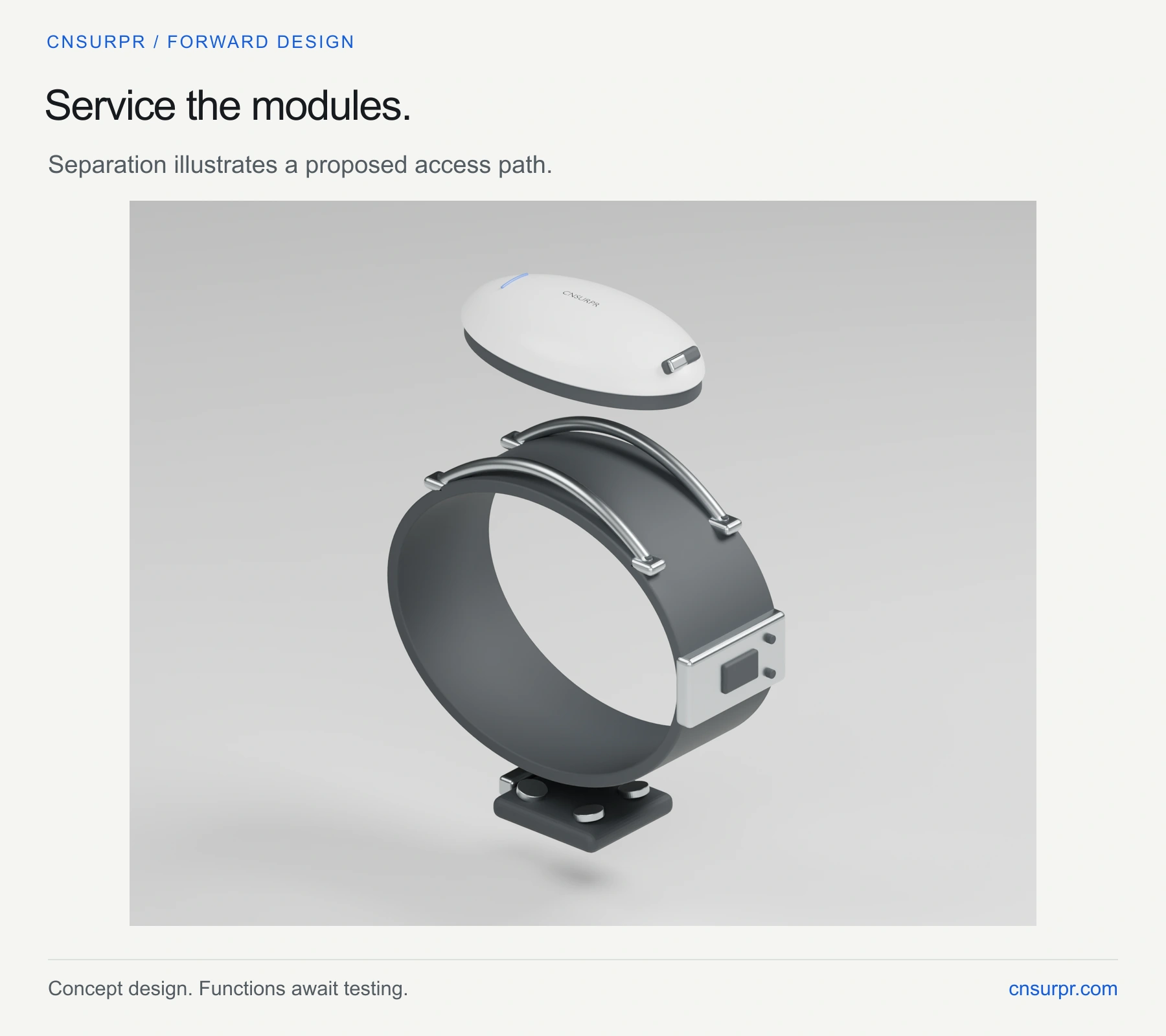
Module access study
The lifted parts are existing concept geometry. No validated internal circuit or assembly sequence is implied.
A development route grounded in hardware
The fixed display model measures 63.50 × 25.00 × 64.02 mm overall. The pod target is about 45 × 25 × 12 mm; this is not a verified internal packing volume. Low-noise surface-muscle sensing, IMU, BLE, protected battery, haptics and replaceable contacts form a proposed functional BOM. There is no working decoder, wearable prototype, verified battery life or supply offer.
The next two planning windows
30–90 days: compare three deliberate commands with touch, buttons and IMU input; examine ecosystem access. 3–6 months: study repeat use, calibration burden and interest in paid prototypes. Drop the approach if simpler inputs work as conveniently.
What could weaken the opportunity?
Buttons, touch controls, IMU gestures and existing wristbands are strong alternatives. Wearable Devices reports only a small revenue base. Extra hardware, calibration and skin contact must earn their place.
Manufacturing brief
Materials and assembly
Proposed PC/ABS or PA12 shell, machined or formed metal supports and a flexible polymer band. Prototype by printing/CNC. Contact metal, finish, skin compatibility, adjustment and sealing are undecided. The two bridges physically support the pod; the display gap is not magnetic levitation. Exterior geometry has no validated cavity, wall thickness, fasteners or tolerances.
Sensing and compute route
Evaluate a low-noise analogue front end, differential electrodes and reference, IMU, low-power BLE controller, battery protection/charging, haptics and a physical stop/status circuit. Compare confirm, cancel and scroll first. Electrode pairing/channel count, antenna clearance, firmware and a host adapter need development; four pictured pads do not define four channels. Remove the band to charge as an initial operating constraint, not a tested safety claim.
Sourcing and cost gaps
Open documentation establishes reference routes, not current stock. No component, tooling, shipping or compliance quotations have been obtained. No price, MOQ or delivery date is offered. Code, receiver-library, PCB and model rights are separate; an MIT firmware license does not license the whole system.
Tests before a hardware claim
Measure deliberate-command success, task time and false activations per hour separately. Include walking, typing, rest, sweat, loose fit, redon, disconnection and haptic feedback. Benchmark buttons, touch and IMU. Electrical isolation, charging, temperature, contact materials, sweat/water ingress, radio, battery transport and destination requirements remain engineering tasks. This is an adult non-medical input concept, with no market approval assertion.
What could make it defensible?
Contact maintenance, stable redon and focused host adapters are hypotheses for differentiation; no moat exists yet. Broad demand and willingness to choose a new brand remain unmeasured. Public issuer, launch and open-source evidence support exploration, not a numerical breakout probability. Prototype comparisons and repeated buyer use will decide whether to continue.
Questions before a sourcing brief
Is this available to order?
This is a concept design. Price, supply, MOQ, delivery, prototype performance and certification are unconfirmed.
Does it work with every computer or glasses?
Interoperability is a development task. Current open references include bridge receivers, not a verified universal direct-HID implementation.
Does the four-pad model define four EMG channels?
No. It is a contact-layout study. The analogue front end, electrode pairing, reference and channel count remain open.
What would count as a useful result?
Repeated task benefit over touch, buttons and IMU, with manageable redon effort and false activations during normal activity.
What can the design demonstrate today?
The images and interactive geometry demonstrate one consistent original appearance and service concept. Proposed functions, power, lifetime and production require prototype evidence. Price, MOQ and lead time remain unconfirmed.
How reliable is the growth forecast?
This is a forward design thesis informed by public shipment, issuer and developer evidence. These sources measure different populations. We will revisit the thesis after 30, 60 and 90 days, including counterexamples and product-use evidence.
How are search and AI discovery addressed?
The page answers product and sourcing questions with paired language URLs, dated evidence and consistent technical descriptions. The phrases below are research candidates whose search volumes remain unverified.
EMG wristband · silent wrist input · replaceable electrode band
Evidence reviewed 2026-11-17
Issuer-reported H1 2026 versus H1 2025 revenue: USD350k versus USD294k, unaudited and consolidated. Net loss USD5.520m. Two periods cannot establish seasonality or forecast unit demand.
Wearable Devices · 24 Aug 2026 ↗Historical September 2025 glasses-and-band announcement, initially a US launch route. It does not establish standalone wristband volume or compatibility with other glasses.
Meta · Sep 2025 ↗MIT firmware reference for a single-channel sensor and IMU route; no code adopted, built or tested on this design.
uMyo firmware ↗CERN-OHL-P-2.0 hardware reference inspected during pre-research. Current component availability, redesign and production duties remain open.
uMyo PCB ↗LGPL-2.1-or-later BLE receiver documentation, reviewed 16 November. It is not universal direct HID. Android bridge licensing is unresolved in the inspected scope; no code copied. Research datasets/models with noncommercial terms are excluded.
uMyo BLE receiver ↗